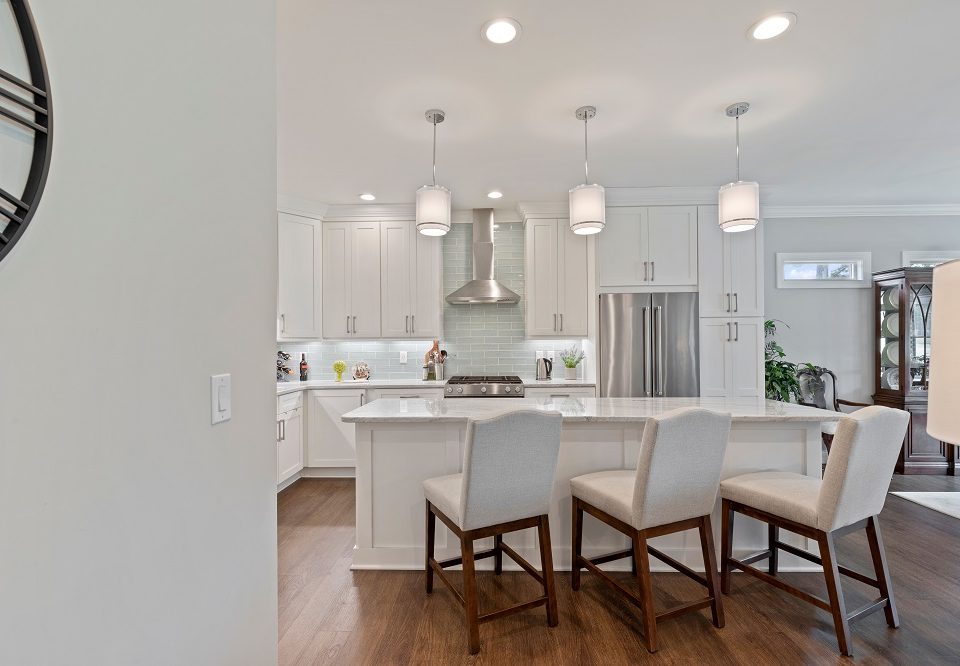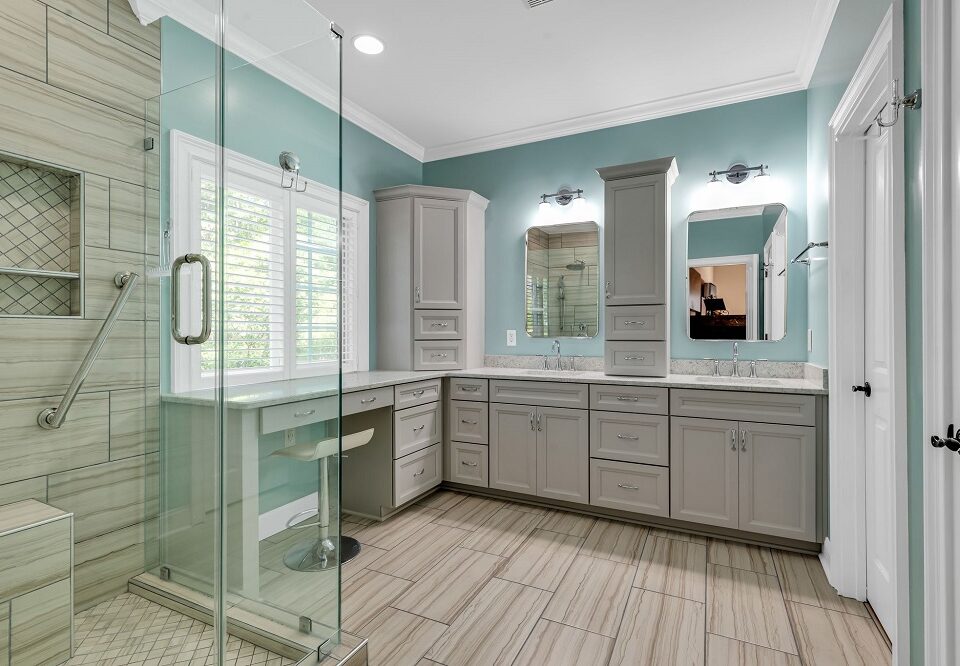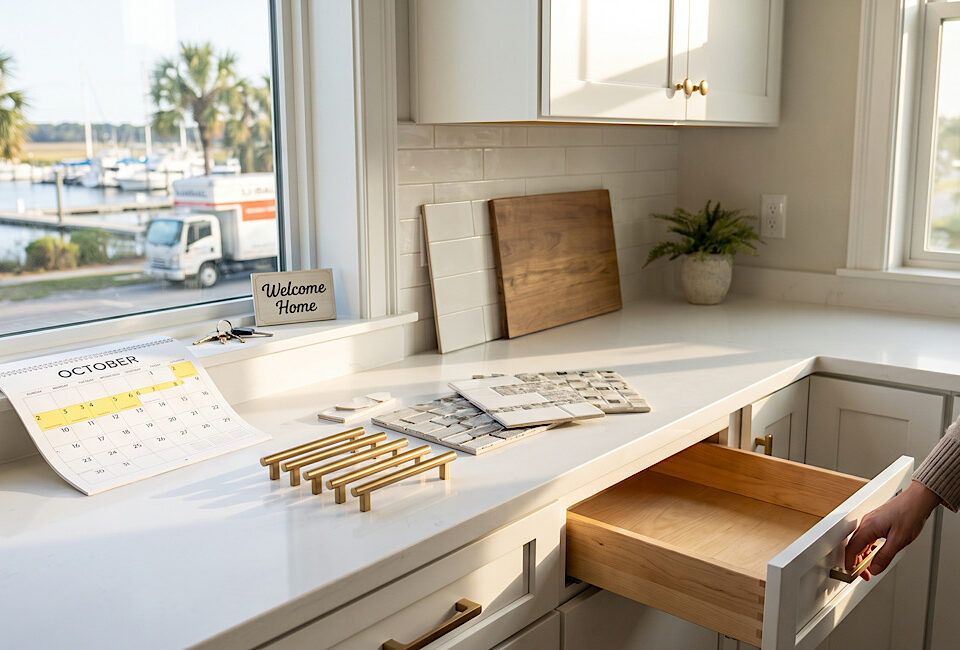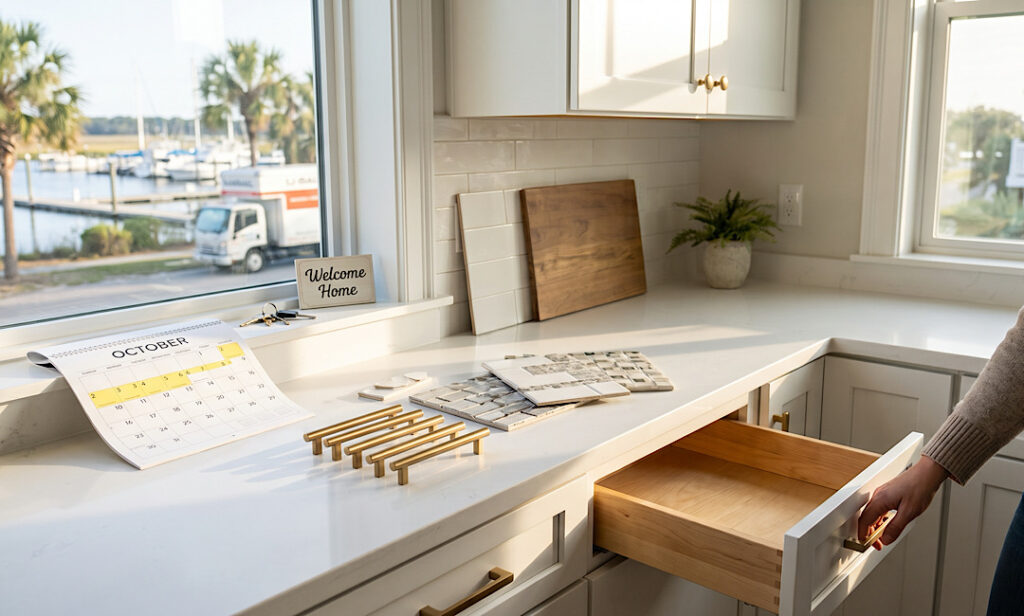

Visit The Cabinet Market at the Myrtle Beach Home Show
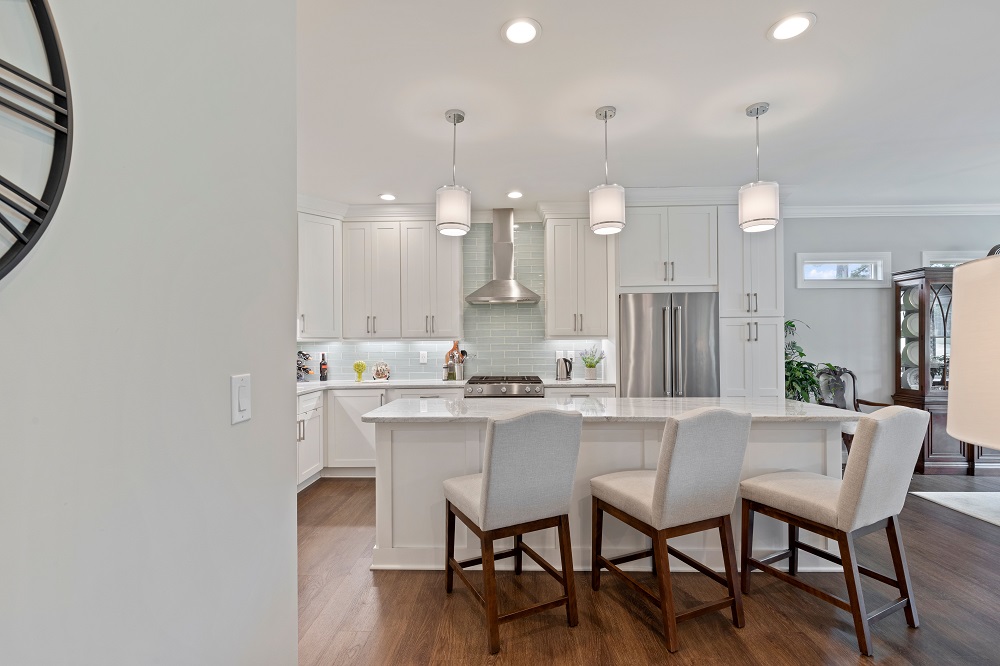
2027 Kitchen Design Trends: What Coastal Carolina Designers Are Watching

Ask what a kitchen remodel costs and you will get a range so wide it is useless, which is frustrating, and also honest, because the honest answer genuinely depends.
But there is a more useful question underneath it: where does the money go? Because most budgets that go wrong do not go wrong on the total. They go wrong on allocation: too much committed to the parts you can see, not enough held back for the parts you cannot, and no room left when something turns up behind a wall.
At The Cabinet Market, we have been quoting kitchens across Horry County since 2015. This is what the money does.
A note on pricing: These ranges reflect what we typically see across Grand Strand projects. Remodeling costs move with material availability, labor demand, and inflation, and the specifics of your home matter just as much. Layout changes, plumbing and electrical work, surprises behind a wall, and the finish level you choose all shift the number meaningfully. Treat these as a planning framework, not a quote. The only accurate figure for your kitchen comes from measuring your space and pricing your actual selections.
The Ranges We Typically See
For the Myrtle Beach and Grand Strand area:
| Project type | Typical range |
|---|---|
| Cabinet refacing | $10,000 – $40,000 |
| Full remodel, remove and replace, no layout change | $20,000 – $60,000 |
| Kitchen renovations generally | $20,000 – $70,000 |
| Large or fully customised kitchens | Can exceed $100,000 |
There is also a rule of thumb worth knowing: spending somewhere between 5% and 15% of your home’s value on a kitchen is a reasonable band to plan within. On a $300,000 home, that is roughly $15,000 to $45,000.
That guideline is not about what you can afford; it is about proportion. A kitchen that costs a third of the house is unlikely to return that at sale, and one that costs 2% will usually look it.
Where the Money Actually Goes
Ranked by how much of the budget each typically consumes.
Cabinetry
Almost always the largest single line, and the one with the widest internal spread. Cabinets are the structure of the room; they determine the layout, the storage, and most of what you see.
What moves the number:
- Stock, semi-custom, or custom. Stock comes in fixed sizes and finishes. Semi-custom allows modification of sizes, finishes and configurations and is where most projects land. Custom is built to the room. The cost gap between them is substantial.
- Box construction. Plywood versus particleboard, and framed versus frameless. This affects durability significantly, and in a coastal climate it matters more than it would inland.
- Finish. Painted finishes generally cost more than stained, because they require more preparation and show more.
- Interior fittings. Pull-outs, dividers, and organisers are priced per unit and add up quickly, though they change daily use more than almost anything else in the room.
The distinction between cabinet grades is genuinely worth understanding before you compare quotes, because two proposals for “new cabinets” can mean very different products.
Countertops
Usually the second largest line, and priced by square footage plus fabrication.
The variables are material, edge detail, and cut complexity. Quartz and granite sit in a broad middle band. Premium natural stone and ultra-compact surfaces sit above it. Laminate sits well below.
Two things that surprise people: fabrication is a real portion of the cost, so an unusual edge profile or a lot of cutouts adds more than the material alone suggests. And an island with a seating overhang usually needs concealed support, which is a separate line item.
Labour
Frequently underestimated because it is invisible in a finished photograph.
Demolition, installation, tile setting, and finish carpentry are all labour-intensive, and tile in particular is priced by the hour more than by the box. A complex backsplash can cost more to install than to buy.
Labour is also where the biggest quality differences hide. Cabinet installation especially: the difference between competent and excellent is entirely in how doors align, how fillers are scribed, and whether anything moves in year three.
Plumbing and electrical
Small if you change nothing. Significant if you change anything.
Keeping the sink where it is and reusing existing circuits keeps this line minimal. Moving a sink, adding an island with plumbing, or bringing an older kitchen up to current electrical requirements moves it substantially, particularly in slab-on-grade homes, common across Horry County, where relocating drains means cutting concrete.
If your home is older and the kitchen has never been updated, budget for this honestly rather than optimistically. Bringing wiring current is not optional work.
Flooring
Varies enormously by material, and by whether it runs under the cabinets or up to them.
Worth deciding early, because flooring interacts with cabinet toe kicks and appliance heights. Deciding it late is how transitions end up looking improvised.
Appliances
The most controllable line on the list, and the one with the widest possible spread: the same kitchen can carry a modest appliance package or one that costs more than the cabinetry.
Worth noting: appliance dimensions drive cabinet dimensions. Choosing appliances late, or changing them after cabinets are ordered, is one of the more expensive mistakes available.
Hardware, lighting and the small things
Individually minor, collectively not. Hardware, under-cabinet lighting, pendants, sink, faucet, and trim add up to a meaningful figure that frequently gets left out of early estimates entirely.
A kitchen with forty pulls at a mid price point is not a rounding error. Put it in the budget from the start.
Good, Better, Best: What Changes at Each Level
A useful way to think about tiers, because the differences are not evenly distributed.
Good. Stock or entry semi-custom cabinetry, laminate or entry quartz countertops, existing layout retained, standard appliances, straightforward tile. The kitchen looks new and functions well. Compromises are mostly in material longevity and configuration flexibility rather than appearance.
Better. Semi-custom cabinetry with plywood construction and interior fittings, quartz or granite, some layout adjustment, upgraded hardware and lighting, better appliance package. This is where most projects land, and where the value curve is steepest: the jump from good to better buys noticeably more than the jump from better to best.
Best. Custom cabinetry, premium surfaces, layout changes, integrated appliances, specialty features. Every element is specified rather than selected. The difference is real, but it is incremental rather than transformative, and it is worth being clear-eyed about that.
The honest observation from a decade of quoting: the largest jump in satisfaction happens between good and better, not between better and best. If your budget is constrained, moving from stock to semi-custom cabinetry with better box construction will do more for you than upgrading the countertop.
The Contingency Nobody Wants to Set Aside
Set aside a contingency. Ten to fifteen per cent is sensible, and higher on an older home.
Not because anyone is planning to spend it, but because opening walls in a house that has been through prior renovations reveals things. Plumbing that was never quite right. Wiring that does not meet current requirements. Subfloor damage from a leak nobody knew about. Framing that is not where the drawings assumed.
The projects that go badly are almost never the ones that encountered a surprise. They are the ones that encountered a surprise with nothing held back, which forces a choice between stopping and cutting something you actually wanted.
A contingency you do not spend is not wasted. It is the difference between a decision and a crisis.
What Actually Drives Your Number Up
If you are trying to understand why one quote differs from another, these are usually the reasons:
- Moving plumbing or gas. The single biggest fork in the road.
- Cabinet grade and construction. Two quotes can both say “new cabinets” and mean entirely different things.
- Kitchen size. Linear feet of cabinetry and square feet of countertop scale directly.
- Ceiling height. Taller ceilings often mean taller cabinets or additional trim work.
- Electrical scope. Older homes needing circuits brought current.
- Tile complexity. Pattern, size, and layout change labour hours substantially.
- Structural changes. Removing a wall means engineering, permits, and framing.
None of these are hidden. All of them can be identified before a contract, provided the estimate is detailed enough to expose them. A quote that is one number with no breakdown is not a quote you can compare.
Where to Spend and Where to Save
After a decade of these conversations, the pattern is consistent.
Worth spending on:
- Cabinet box construction. It is structural, permanent, and in a coastal climate it determines lifespan. This is the least glamorous upgrade and the one people are most glad they made.
- Installation quality. Excellent cabinetry installed poorly is worse than good cabinetry installed well.
- Interior storage. Pull-outs and organisers change how the kitchen works every single day, and retrofitting them later costs more.
- Anything behind a wall. Plumbing, wiring, and ventilation are expensive to revisit.
Reasonable places to economize:
- Appliances, at least initially. They are replaceable without touching anything else.
- Decorative tile quantity. A simpler backsplash executed well beats an elaborate one executed cheaply.
- Lighting fixtures. Easy to upgrade later.
- Countertop material, within reason. The gap between a mid quartz and a premium slab is aesthetic rather than functional.
Where refacing makes sense: if the cabinet boxes are sound and the layout works, refacing delivers a large visual change for meaningfully less than replacement. If the layout is wrong or the boxes are failing, refacing preserves the problem in a nicer finish.
Get a Breakdown, Not a Number
The most useful thing you can do is ask for an itemized estimate. Cabinetry, countertops, labour, plumbing and electrical, flooring, hardware and lighting, listed separately.
An itemised estimate lets you see where the money is going, compare quotes meaningfully, and adjust deliberately, moving budget from a countertop upgrade into better cabinet construction, for instance, rather than negotiating a total downward and hoping the reductions land somewhere harmless.
It also tells you something about the contractor. A detailed estimate means someone measured, specified and thought. A single number means someone guessed.
If you would like a genuine breakdown for your kitchen, that is what our estimating process produces: itemised, with selections priced as specified rather than as allowances. Start with our kitchen remodeling service, browse cabinetry options and countertop materials, and see completed work at comparable budgets in our portfolio.
Frequently Asked Questions
How much does a kitchen remodel cost in Myrtle Beach?
Full remodels that keep the existing layout typically run $20,000 to $60,000, with kitchen renovations generally spanning $20,000 to $70,000. Large or fully customized kitchens can exceed $100,000, and cabinet refacing typically runs $10,000 to $40,000. Costs move with materials, labor demand and inflation, so treat these as planning ranges rather than quotes.
How much of my home’s value should I spend on a kitchen?
A common guideline is 5% to 15% of the home’s value, roughly $15,000 to $45,000 on a $300,000 home. It is a proportion guide rather than an affordability rule: spending far above the band rarely returns at resale, and spending far below usually shows.
What is the most expensive part of a kitchen remodel?
Cabinetry, almost always. It is the structure of the room and has the widest internal price spread depending on whether it is stock, semi-custom or custom, and how the boxes are built. Countertops are typically second, followed by labour.
How much should I set aside for contingency?
Ten to fifteen per cent, and more on an older home. Opening walls in a house that has been renovated before regularly reveals plumbing, wiring or subfloor issues. A contingency turns those discoveries into decisions instead of crises.
Is cabinet refacing worth it?
It is, when the cabinet boxes are structurally sound and the layout works. Refacing delivers a large visual change for considerably less than replacement. If the layout is wrong or the boxes are deteriorating, refacing preserves those problems behind a new finish.
Why do kitchen remodel quotes vary so much?
Usually because they include different things. Cabinet grade and box construction, whether plumbing moves, electrical scope, tile complexity and appliance packages all vary enormously. A single-number quote cannot be compared to anything; ask for an itemized breakdown.
What should I prioritize if my budget is tight?
Cabinet box construction and installation quality, then anything behind a wall: plumbing, wiring, ventilation. Appliances, lighting fixtures and decorative tile are all straightforward to upgrade later without disturbing anything else.
Get a Free Detailed Estimate
Not a single number: an itemised breakdown with your selections priced as specified, so you can see exactly where the budget goes and adjust it deliberately. Get a free detailed estimate or call (843) 293-3030.