
The Best Two Months to Remodel a Myrtle Beach Second Home or Rental Is About to Start

Cabinet Hardware for Salt Air: Finishes That Corrode and Finishes That Last
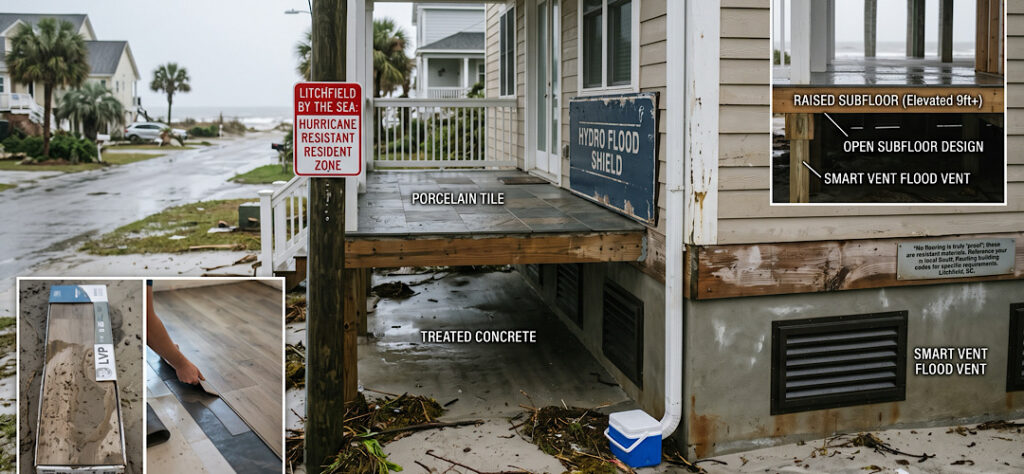
Every waterproof flooring product sold in South Carolina is telling the truth and missing the point at the same time.
The plank genuinely is waterproof. Submerge it in a bucket for a week and it will not swell, delaminate, or come apart. What the label does not tell you is that your floor is not a plank. Your floor is an assembly (plank, underlayment, adhesive or locking system, subfloor, fasteners, and whatever is in the cavity below) and water does not politely stop at the top layer.
At The Cabinet Market, we work in homes from Murrells Inlet to Little River, and we have seen the same conversation play out after every significant storm: an owner with a waterproof floor, standing on a floor that has to come out. Not because the product failed, but because the water went around it.
Here is what actually happens to each material, what determines whether a floor can be dried and saved, and what to install if you would rather not have this conversation again.
Not All Storm Water Is the Same
Before talking about materials, it is worth separating three very different events that homeowners tend to describe with the same phrase.
Clean water intrusion is a supply line, a water heater, or rain driven through a window opening. It is sanitary at the moment it arrives. Materials have the best chance of being dried and saved.
Grey water carries some contamination: a dishwasher discharge, a washing machine line, water that has run across dirty surfaces.
Storm surge and flood water is black water. It has moved across roads, yards, septic systems, and whatever else was in its path. Restoration professionals treat it as contaminated regardless of how it looks, and the standard response is removal rather than drying for most porous materials.
This distinction matters more than the flooring material itself. A solid hardwood floor soaked by a burst supply line may be recoverable. The same floor touched by two inches of surge water usually is not, not because the wood is unsalvageable in principle, but because what came with the water cannot be cleaned out of it.
The other variable is time. Mold does not need long to establish itself in a warm, humid, unventilated coastal house, often a day or two is enough. A floor that gets dried aggressively within the first day has dramatically better odds than the identical floor found four days later.
How Each Flooring Type Behaves After Water Intrusion
Porcelain and ceramic tile
The most water-tolerant option, and it is not close.
Porcelain in particular absorbs very little moisture. Tile, thinset, and grout are all unaffected by water in any meaningful way. After a flood, tile is typically cleanable and reusable.
The failure point is never the tile; it is what is beneath it. If water sits on a tile floor and finds its way through grout lines or perimeter gaps into a plywood subfloor, the tile can be in perfect condition sitting on a subfloor that has to be replaced. Removing tile to get at that subfloor destroys the tile anyway.
On a concrete slab, which describes a large share of Grand Strand homes, tile is close to the ideal answer.
SPC and WPC luxury vinyl
These are the two rigid-core vinyl categories, and the difference between them is worth understanding because it is genuinely relevant here.
SPC (stone plastic composite) uses a dense mineral-and-PVC core. It is harder, thinner, and more dimensionally stable under temperature swings, relevant in a coastal house where the HVAC may be turned down for weeks.
WPC (wood plastic composite) uses a foamed core with wood flour. It is thicker, softer, and warmer underfoot, and it hides minor subfloor imperfections better.
Both cores are genuinely waterproof. Neither will swell.
What fails is the interface. Click-lock floating floors have seams, and water that gets onto the surface finds those seams and travels beneath the floor, where it sits between the plank and the subfloor with no airflow. The floor looks fine. The underside is a problem. On a floating installation, planks can often be lifted, the substrate dried, and the same planks reinstalled, which is a genuine advantage. On a glue-down installation, that is much harder.
For a coastal home, this is the category that offers the best combination of realistic performance and cost.
Sheet vinyl
Underrated in flood situations. A single continuous sheet with heat-welded or sealed seams gives water very few entry points, which is precisely why it remains standard in commercial healthcare settings.
The catch is the same as everywhere else: water that reaches the perimeter or a cut edge gets underneath, and because the sheet is impermeable, it traps that moisture rather than letting it evaporate.
Laminate
This is the material that most often surprises homeowners, and it is the one to be most careful about.
Laminate uses a high-density fibreboard core. HDF is wood fibre and resin compressed under pressure, and when it takes on water it swells irreversibly. The edges of each plank puff up, the joints lift, and the decorative surface layer separates. There is no drying it back. Once swollen, it is finished.
Many laminates are now marketed as “water resistant,” and that claim is generally honest for what it describes: spills wiped up promptly, a pet accident, a dropped glass. It does not describe standing water. If a laminate floor is submerged, plan on replacement.
Engineered hardwood
More stable than solid wood because the plywood core layers are cross-laminated, which resists the cupping that solid boards are prone to. That stability is real and it helps in humid coastal conditions generally.
Under actual water intrusion, though, engineered wood has a specific vulnerability: the wear layer is a veneer bonded to the core. Sustained moisture attacks that bond, and delamination (the veneer separating or bubbling) cannot be repaired. Sanding does not fix it, and on thinner wear layers there may not be enough material to refinish at all.
Engineered wood dried quickly after clean water may survive. After surge water, it usually does not.
Solid hardwood
Solid wood absorbs water across the width of each board, and as the bottom takes on more moisture than the top, the boards cup. Dry it too fast and they crown instead. Dry it unevenly and they do both in different parts of the room.
The redeeming quality is thickness. A solid three-quarter-inch floor that is dried carefully (slowly, with proper equipment, monitored to a stable moisture content) can often be sanded flat and refinished afterward. That is a real second life that no other wood product offers.
But “dried carefully” is doing significant work in that sentence. It means professional drying equipment within the first day or two, not fans and open windows in August. And it applies only to clean water.
Carpet
Carpet and pad should be treated as two separate items.
The pad is a sponge and should be assumed lost in any meaningful water event. Carpet itself may be salvageable after clean water if it is extracted and dried quickly and the pad is replaced. After storm or flood water, the standard guidance is removal, and it is the right call. Carpet holds contaminants at the fibre level, and the backing and seam adhesives do not respond well to saturation.
The Part That Actually Decides It: What Is Underneath
This is the section most flooring articles skip, and it is the one that determines outcomes.
On a concrete slab, you are in good shape. Concrete tolerates wetting, dries out, and does not rot. Tile, glue-down vinyl, and rigid-core floating floors all perform well over slab. This describes a large proportion of Grand Strand construction, and it is a genuine advantage.
On a raised wood floor system, the calculation changes entirely. Plywood or OSB subfloor, joists, and, critically, insulation and a crawl space below. Water that gets past the finished floor saturates the subfloor and drains into a crawl space that may have poor ventilation and no drying capacity at all. That is where persistent mold problems begin, and it is invisible from inside the house.
Two practical implications:
- If you are on a raised floor system, the finished flooring is the least important part of your flood resilience. Crawl space encapsulation, drainage, and ventilation matter more.
- Any water event on a raised floor warrants inspecting below, not just drying above. A dry-looking floor over a saturated subfloor is the most common expensive mistake we see.
Why Salt Water Is a Different Problem
Fresh water and salt water are not equivalent, and coastal homeowners are rarely told the difference.
Salt does not evaporate. Water leaves, salt stays, embedded in porous materials as crystalline residue.
Salt attracts moisture. Salt residue is hygroscopic: it pulls humidity out of the air. A material that has been soaked in salt water and dried can re-dampen on a humid day months later, which is why “it dried out fine” sometimes turns into a problem the following summer.
Salt corrodes fasteners. Nails, screws, staples, and metal trim in contact with salt residue corrode faster. On a floor, that means squeaks and loosening over time, not immediate failure.
The practical upshot: after salt water exposure, rinsing with fresh water before drying is not optional. Drying salt in place locks the problem into the material.
Save It or Replace It: An Honest Decision Framework
| Flooring | Clean water, dried fast | Storm surge / flood water |
|---|---|---|
| Porcelain / ceramic tile | Save: check subfloor | Usually save: verify subfloor |
| SPC / WPC vinyl (floating) | Save: lift, dry, reinstall | Often save the planks; assess substrate |
| SPC / WPC vinyl (glue-down) | Usually save | Frequently replace |
| Sheet vinyl | Save if edges stayed sealed | Usually replace |
| Laminate | Replace if swollen at all | Replace |
| Engineered hardwood | Possible with fast professional drying | Usually replace |
| Solid hardwood | Often save: dry slowly, then refinish | Usually replace |
| Carpet | Replace pad; carpet may survive | Replace both |
Two rules that apply regardless of material:
- Photograph everything before you touch it. Insurance claims are decided on documentation.
- Moisture meters, not appearances. A floor that feels dry on top can hold significant moisture underneath. If someone is telling you a floor is dry without measuring it, they are guessing.
What to Install If You Want to Stop Worrying
If you are replacing flooring in a coastal home and resilience is a priority, the honest ranking:
Best case: porcelain tile over a concrete slab. Effectively immune. The trade-offs are hardness underfoot, cost, and cold in winter.
Best balance: SPC rigid-core vinyl. Waterproof core, dimensionally stable through temperature swings, comfortable, and if installed as a floating floor it can be lifted and reinstalled after a water event. For most Grand Strand homes this is the sensible answer.
Reasonable with eyes open: engineered hardwood. If you want real wood, this is the version that handles coastal humidity best. Accept that a significant water event likely means replacement.
Avoid in flood-exposed areas: laminate and carpet. Laminate’s core is the wrong material for the risk. Carpet in a ground-floor coastal room is a problem waiting for a bad week.
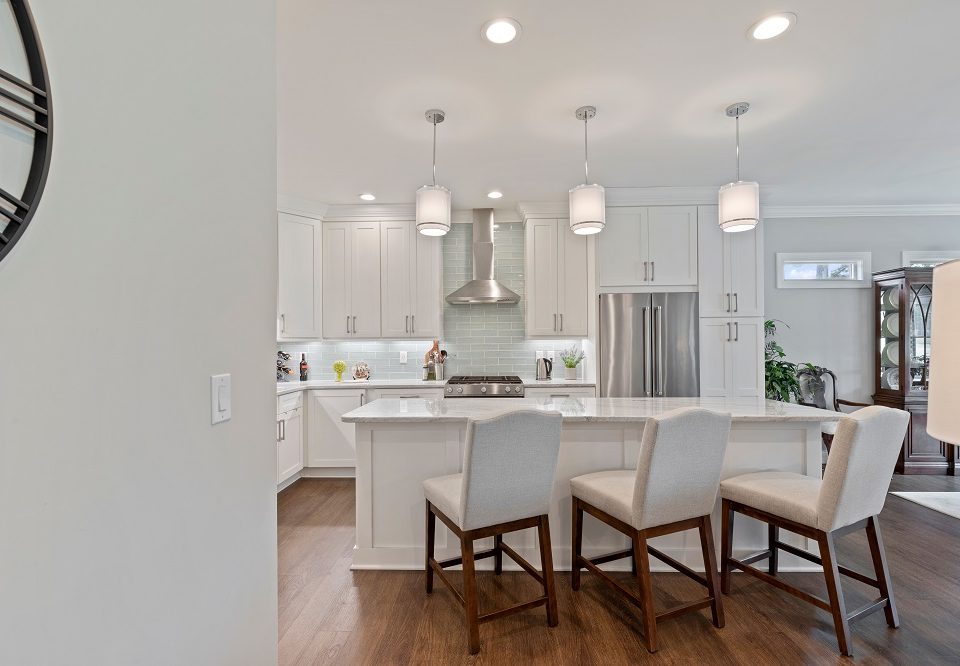
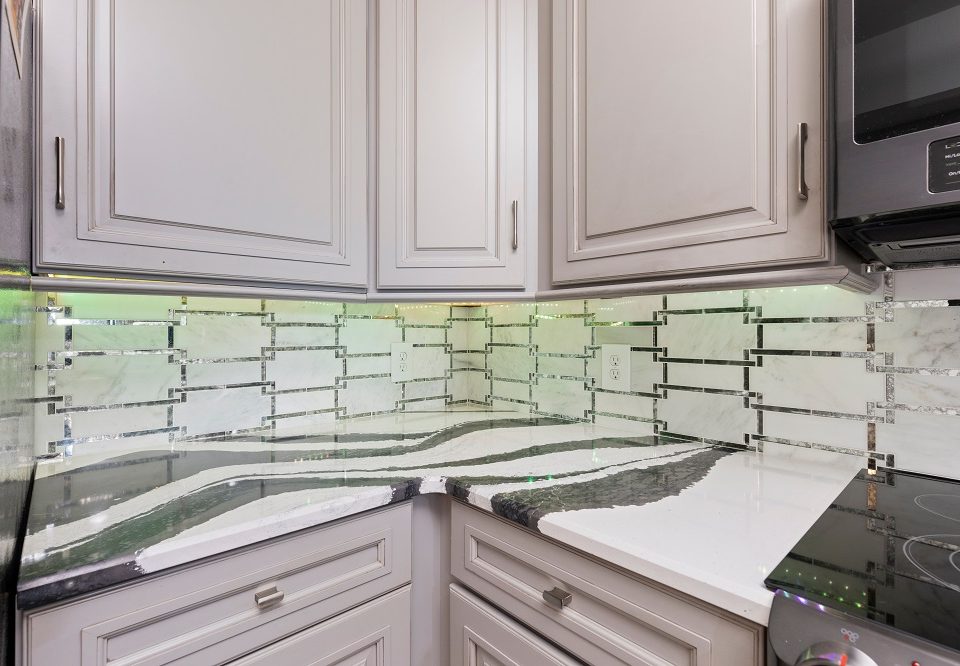
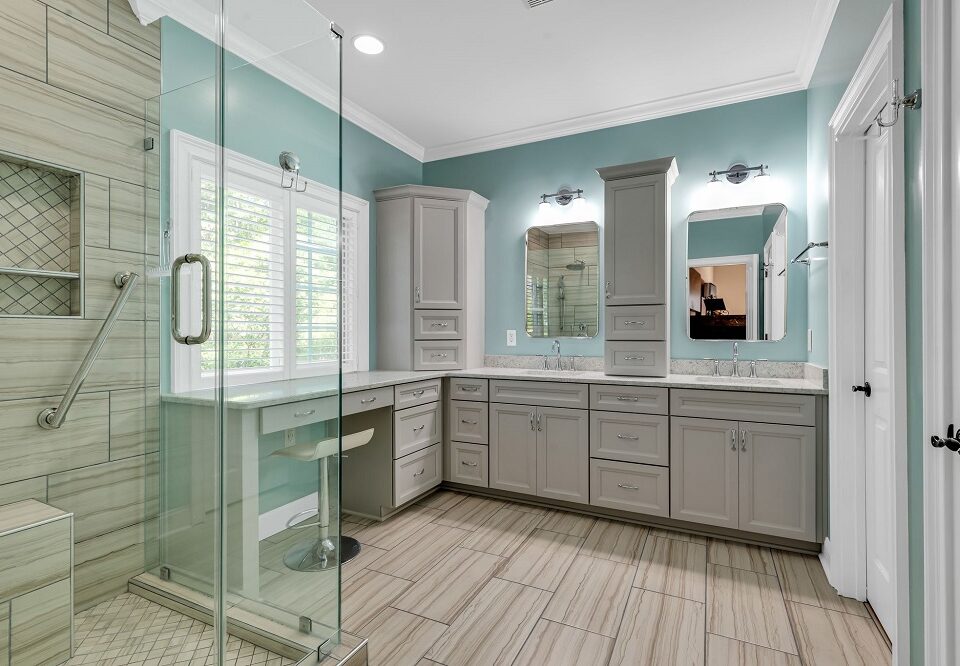
One consideration that gets overlooked: choose flooring at the same time as cabinetry, not after. Flooring interacts with cabinet toe kicks, appliance heights, and transitions, and in a room where you are also making decisions about kitchen cabinetry or a bathroom renovation, sequencing those choices together avoids expensive corrections. Our overview of flooring options for coastal conditions goes deeper on material selection for this climate.
The Honest Summary
No floor makes a house flood-proof. What flooring choice actually buys you is recovery speed: whether a water event means a week of drying and reinstallation, or a full replacement and a mold remediation invoice.
In a coastal home, that difference is worth designing for before the storm rather than after.
Frequently Asked Questions
Is waterproof flooring actually waterproof?
The plank is. The floor is not. Waterproof cores like SPC and WPC will not swell, but water travels through seams and around perimeters to the subfloor beneath, where it causes the real damage. “Waterproof” describes the product, not the installed assembly.
What is the difference between WPC and SPC flooring?
SPC uses a dense stone-and-PVC core: harder, thinner, and more dimensionally stable in temperature swings. WPC uses a foamed wood-composite core: thicker, softer, warmer underfoot, and better at hiding subfloor imperfections. Both cores are waterproof; SPC is generally the better choice for coastal homes that sit unoccupied.
Can laminate flooring be saved after a flood?
Generally no. Laminate’s high-density fibreboard core swells irreversibly when saturated, lifting the joints and separating the surface layer. Water-resistant laminate handles spills, not standing water.
Can hardwood floors be saved after water damage?
Solid hardwood often can be, if the water was clean and professional drying begins within the first day or two. It can then be sanded and refinished. Engineered hardwood is less recoverable because moisture attacks the bond holding the veneer to the core, and delamination cannot be repaired.
Does salt water damage flooring differently than fresh water?
Yes. Salt remains in the material after the water evaporates, attracts humidity from the air so materials can re-dampen months later, and accelerates corrosion of fasteners. Salt-exposed materials should be rinsed with fresh water before drying.
What is the most water-resistant flooring for a Myrtle Beach home?
Porcelain tile over a concrete slab is the most resilient. For a better balance of comfort, cost, and recovery, SPC rigid-core vinyl installed as a floating floor is the practical choice for most homes here.
How quickly do I need to dry a wet floor?
As fast as possible. In warm, humid coastal conditions mold can establish within a day or two. Floors dried within the first 24 hours have substantially better outcomes than the same floors addressed several days later.
Request a Free Flooring Assessment
If you are replacing flooring after a storm, or you would rather choose the resilient option before the next one, we can walk your space and talk through what actually makes sense for your subfloor and your risk. Request a free flooring assessment or call (843) 293-3030.