Hurricane Season Flooring: What Actually Survives Water Intrusion in Coastal SC Homes

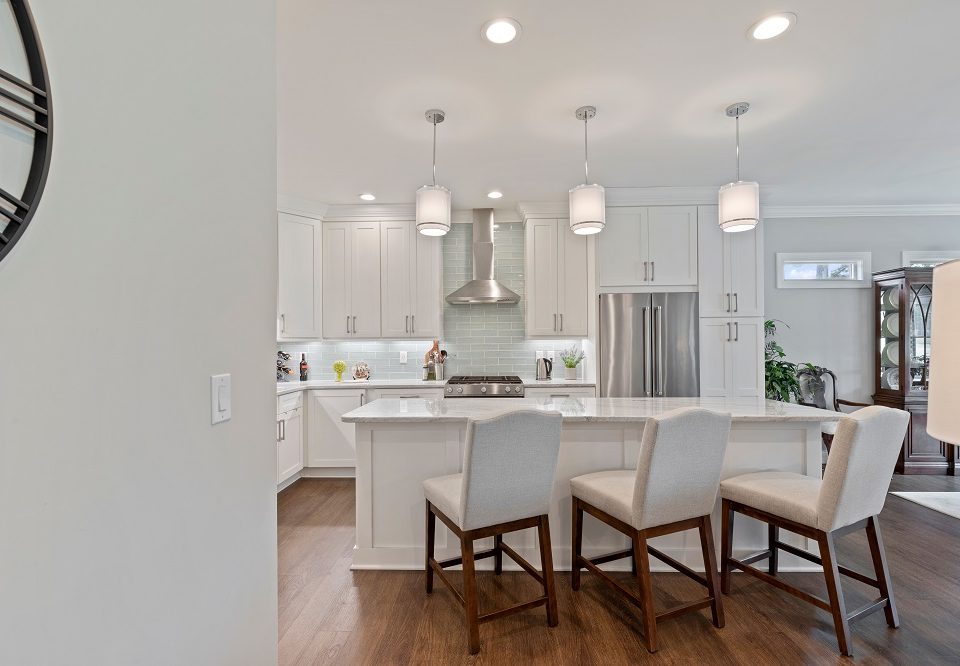
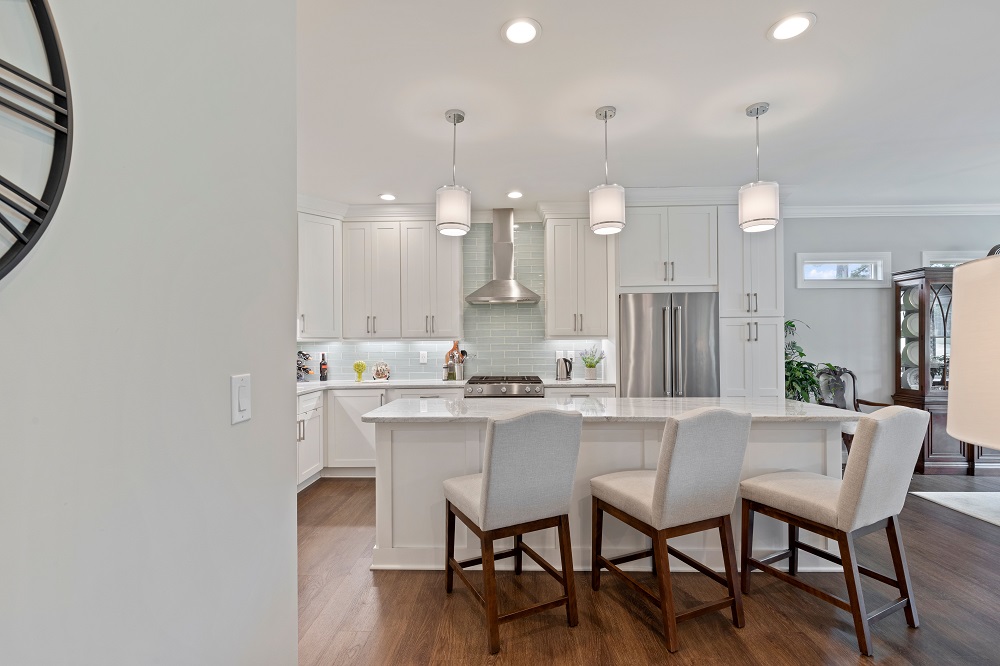
Kitchen Island Sizing: How Much Space You Actually Need in a Carolina Forest Home
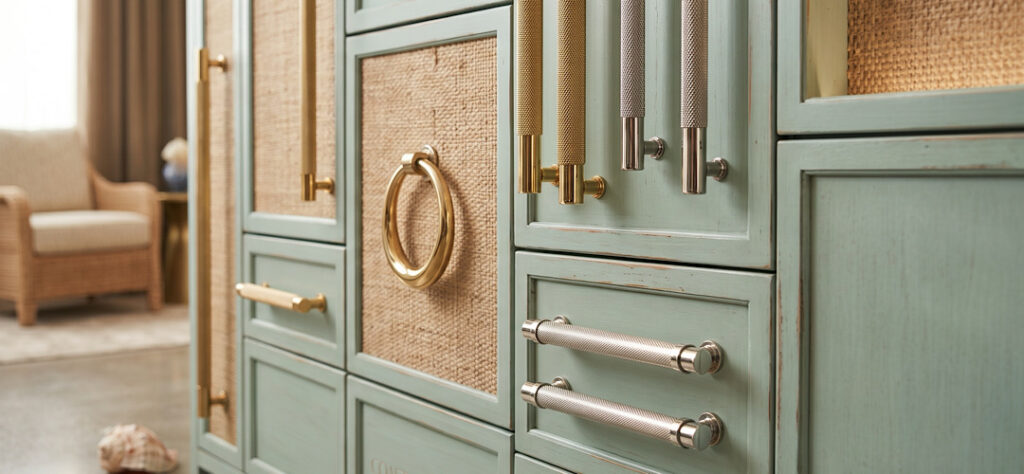
Cabinet hardware is the one part of a kitchen that people replace twice.
Not because they changed their mind about the style, because three or four years after a renovation, the pulls on the island have gone dull and blotchy, one of them has a rust bloom creeping out from under the screw head, and the finish has started flaking at the corners where hands touch it most.
Inland, that same hardware would still look new. Along the Grand Strand, it does not, and the reason has nothing to do with how carefully anyone cleaned it.
At The Cabinet Market, hardware is usually the last decision in a project and the first thing to show its age. It is also the cheapest thing to get right at the start and the most annoying to redo. So here is what actually happens to metal in coastal air, and what to buy if you would rather do this once.
What Salt Air Actually Does to Metal
Coastal air carries chloride ions, fine salt particles suspended in humidity that settle on every surface in the house, including surfaces inside closed cabinets.
Chlorides are unusually aggressive toward metal for two reasons.
First, they break down the passive oxide layer that protects metals like stainless steel and aluminium. That invisible layer is what makes stainless “stainless”; chlorides attack it locally, which is why coastal stainless tends to fail in small pits and spots rather than uniformly.
Second, salt is hygroscopic: it pulls moisture out of the air. A salt deposit on a cabinet pull does not simply sit there. It holds a microscopic film of moisture against the metal, continuously, including on days that feel perfectly dry. Corrosion is not an occasional event during storms; it is a slow constant.
This is why hardware inside an air-conditioned kitchen still degrades. It is not being splashed with seawater. It is living in air that never fully dries out at the metal’s surface.
The Real Problem Is the Base Metal, Not the Finish
Here is the distinction that decides everything, and it is almost never printed on the packaging.
Most inexpensive cabinet hardware is zinc die-cast, a zinc alloy poured into a mould, then plated with a thin decorative layer to look like brass, bronze, nickel, or black. The plating is what you see and what the finish name refers to. The zinc underneath is the actual object.
That construction is fine in Charlotte. On the coast it has a predictable failure sequence:
- The plating gets breached somewhere: a scratch, a wear point where thumbs land, a nick during installation, or a micro-pore that was always there.
- Salt-laden moisture reaches the zinc through that breach.
- Zinc corrodes readily, and it corrodes underneath the plating, spreading sideways from the breach.
- The corrosion product takes up more volume than the metal it replaced, so it lifts the plating from below.
- The finish flakes, and it flakes in patches, which looks far worse than uniform wear.
Nothing about that sequence is preventable by cleaning. Once the base metal is exposed, the clock is running.
Solid brass and solid stainless hardware do not have this failure mode, because there is no dissimilar base metal hiding under the surface. They can tarnish, patina, or spot, but they corrode as one material, gradually and cosmetically, rather than delaminating.
That is the entire argument for spending more on hardware in a coastal house. Not prestige. Construction.
Finish by Finish: What Holds Up on the Coast
Solid brass, unlacquered
The most durable choice available, and the one that requires the most honesty about expectations.
Brass is a copper-zinc alloy that is inherently corrosion resistant. Unlacquered (sometimes sold as “living finish” or “natural brass”) means there is no protective coating at all. The metal is exposed and will develop a patina: bright yellow at first, then warmer and browner, darker in recessed areas, brighter where hands touch it.
That is not failure. That is the product doing what it is designed to do, and along the coast it is genuinely beautiful; the patina develops faster and more richly in salt air than it does inland.
The caveat: it is not reversible without polishing, and it will never look uniform again. If you want hardware that looks identical in year five to year one, this is the wrong choice. If you like the idea of hardware that ages like a boat fitting, it is the best one available.
One technical note worth asking about: brasses with very high zinc content can be susceptible to dezincification in chloride environments, where zinc leaches out and leaves a weakened, porous copper structure. Better-quality brass alloys are formulated to resist it. This is a reasonable question to ask a supplier about a specific line.
Lacquered brass and gold tones
Brass with a clear protective coating over it, intended to hold the bright new-brass colour indefinitely.
The problem is that the lacquer is the weak point. It wears through at high-touch areas first (the centre of a pull, the top of a knob) and once it does, the brass beneath begins to patina only in those spots. You end up with bright lacquered brass everywhere and dark patina where hands land, which reads as damage rather than character.
If you want a gold tone that stays consistent, PVD-finished brass is the better answer. If you are relaxed about ageing, unlacquered is better. Lacquered brass is the option that satisfies neither preference well in this climate.
Stainless steel: and why 304 vs 316 matters
“Stainless” is a family, not a material, and the difference between grades is meaningful here.
Type 304 is the common one, the standard for kitchen appliances and most consumer stainless. It performs well in most of the country. In marine environments it is prone to tea staining: light brown surface discolouration that appears in patches. It is largely cosmetic and does not compromise the metal structurally, but it looks like rust, it recurs, and it is difficult to fully remove.
Type 316 contains molybdenum, which substantially improves resistance to chloride attack. It is the grade used in genuine marine hardware, and it is the reason boat fittings survive conditions that would stain 304 within a season.
You cannot tell them apart by looking. If coastal durability is the priority, ask for the grade specifically; a supplier who knows their product will know the answer.
Oil-rubbed bronze
This finish name covers two completely different products, which is why homeowners report wildly different experiences with it.
True oil-rubbed bronze is a chemically darkened living finish over solid brass or bronze. Like unlacquered brass, it changes over time: high-touch areas rub back toward copper undertones, creating the highlight-and-shadow effect people buy it for. It ages well on the coast.
“Oil-rubbed bronze” as a coating over zinc die-cast is a dark paint or plating over a cheap base metal, and it fails the way all plated zinc fails: chipping at edges, flaking around screw heads, and a base metal that corrodes once exposed.
Same name on the box. Entirely different outcomes in year four. Ask what is underneath.
Matte black
The most popular finish of the past several years, and its coastal performance depends completely on how the black was applied.
Powder coat is a dry polymer applied electrostatically and baked. It is durable and attractive, but it is fundamentally a coating; it can chip at edges and around fasteners, and whatever is underneath is then exposed. Over solid brass or stainless, a chip is a cosmetic problem. Over zinc die-cast, it is the start of the failure sequence.
PVD (physical vapour deposition) bonds an extremely thin, extremely hard layer to the substrate at the molecular level. It is the most durable decorative finish generally available for hardware, significantly more resistant to wear and corrosion than plating or powder coat. It costs more and it is worth it in this climate.
If you want matte black on the coast, ask whether it is PVD. If it is, buy it confidently. If it is powder coat over zinc, expect to replace it.
Polished chrome and nickel
Both are typically plated finishes, which puts them back in the base-metal conversation.
Over solid brass, both perform reasonably. Chrome is hard and bright; polished nickel is slightly warmer and shows fingerprints less aggressively than chrome does.
Over zinc, both pit. Chrome in particular tends to develop small dark pinpoints that cannot be polished out, because the corrosion is beneath the plating rather than on it.
Brushed or satin nickel is the more forgiving version of this family; the texture hides early spotting far better than a mirror finish does, which is why it remains a sensible default for coastal kitchens where someone wants a silver tone without thinking hard about it.
The Screws Will Fail Before the Pulls Do
This is the most common oversight we see, and it is almost always invisible until it is ugly.
Cabinet hardware ships with machine screws, and on a great deal of hardware, including hardware that is otherwise excellent: those screws are plain or lightly plated steel. Steel rusts in salt air far faster than brass or stainless.
What happens is that the screw head corrodes, and the rust bleeds outward onto the cabinet door around it. On a painted white or light-coloured door, that produces a small orange halo around every pull in the kitchen. The hardware is fine. The doors look terrible.
The fix costs almost nothing: specify stainless or solid brass screws for the whole job. Most suppliers can provide them, and if not, they are available separately. On a kitchen with forty pulls, this is a small line item that prevents a problem that is otherwise permanent: rust bleed stains the finish, and cleaning it does not fully remove it.
Also worth knowing: mixing metals in contact accelerates corrosion of the less noble metal, a process called galvanic corrosion. A steel screw in direct contact with brass hardware in a humid, salt-laden environment is precisely that scenario. Matching the fastener to the hardware is not fussiness.
How to Tell Good Hardware From Cheap Hardware in the Showroom
You do not need a metallurgy background. You need about ten seconds per piece.
- Pick it up. Solid brass is noticeably heavy for its size. Zinc die-cast feels light and slightly hollow. This is the single most reliable quick test.
- Look at the back and the ends. Die-cast parts often show faint mould seam lines and a slightly grainy cast texture. Machined solid brass looks and feels denser.
- Check the screw. If a manufacturer supplies a cheap steel screw with an otherwise premium-looking pull, that tells you something about the rest of the specification.
- Ask two questions. “What is the base metal?” and “How is the finish applied?” A supplier who sells quality hardware will answer immediately. Vagueness is itself an answer.
- Do not judge by price alone. Price correlates with quality but does not guarantee it. A heavy solid-brass pull with a PVD finish at a mid price beats a light zinc pull with a designer name at a high one.
We keep physical samples from Top Knobs, Berenson, Atlas Homewares, Liberty Hardware, Jeffrey Alexander and Laurey in the showroom precisely because this is a decision that photographs badly. Weight, texture, and how a finish catches light are things you have to handle.
What We Recommend by Distance From the Water
Exposure is not uniform across the Grand Strand, and it is reasonable to spend differently based on where a house sits.
Oceanfront and first row: North Myrtle Beach, Garden City Beach, Surfside Beach. This is the harshest exposure, with salt spray as well as salt-laden humidity, and often with windows open. Solid brass, 316 stainless, or PVD finishes. Stainless or brass fasteners are not optional. This is not the place to economise on hardware.
Within a mile or two of the ocean. Salt-laden air without direct spray. Solid brass, PVD finishes, and quality powder coat over solid substrates all perform well. Avoid plated zinc.
Inland: Carolina Forest, Conway, Socastee. Meaningfully gentler. Good plated hardware over a solid base metal performs acceptably, though upgraded fasteners remain a cheap insurance policy.
Any property that sits empty for long stretches. Treat it as one step harsher than its location suggests. Homes with reduced air conditioning between visits spend weeks in high humidity, which accelerates everything described above.
Hardware Is the Cheapest Way to Learn Whether Quality Shows
If you are unsure whether upgraded hardware is worth it, this is the easiest thing in a kitchen to test. It is the smallest line item in a kitchen remodel, it is fully reversible, and it is the part of the room that hands touch every single day.
It also pairs naturally with the interior of the cabinet. If you are already opening drawers to swap pulls, it is worth looking at what is behind the doors: storage accessories and pull-outs change how a kitchen works far more than most people expect. And if the cabinetry itself is dated, hardware alone will not rescue it.
But if the boxes are sound and the kitchen simply looks tired, new hardware chosen properly for this climate is the highest-return hour you will spend on the room.
Frequently Asked Questions
What cabinet hardware finish is best for a coastal home?
Solid brass (either unlacquered or with a PVD finish) and 316 stainless steel are the most durable options in salt air. What matters more than the finish name is the base metal underneath: solid brass and solid stainless corrode gradually and cosmetically, while plated zinc die-cast flakes once the plating is breached.
Why does my cabinet hardware look corroded after only a few years?
Almost always because it is plated zinc die-cast. Once the decorative plating is scratched or worn through, salt-laden moisture reaches the zinc underneath, which corrodes and lifts the plating from below. It is a construction issue, not a cleaning issue.
Is 316 stainless steel really better than 304 near the ocean?
Yes. 316 contains molybdenum, which substantially improves resistance to chloride attack. Type 304 is prone to tea staining (light brown surface discolouration) in marine environments. The two look identical, so you have to ask.
Does matte black cabinet hardware hold up on the coast?
It depends entirely on how it was applied. PVD matte black is extremely durable and performs well. Powder-coated matte black over zinc die-cast chips at edges and around fasteners, and once chipped the base metal corrodes.
Should I worry about the screws that come with cabinet hardware?
Yes, and this is the most overlooked detail in coastal kitchens. Many pulls ship with plain steel machine screws, which rust in salt air and bleed orange stains onto the cabinet door around each pull. Specify stainless or solid brass screws; it is a small cost that prevents permanent staining.
Will unlacquered brass hardware turn dark?
It will patina, and faster on the coast than inland, warmer and browner overall, darker in recesses, brighter where hands touch it. That is the intended behaviour of a living finish, not a defect. If you want a finish that stays visually identical over time, choose PVD instead.
How can I tell if hardware is solid brass or plated zinc in a showroom?
Weight is the most reliable quick test: solid brass feels notably heavy for its size, and zinc die-cast feels light. Mould seam lines and a grainy cast texture on the back also point to die-cast. When in doubt, ask what the base metal is.
See Hardware Options in Our Showroom
Weight, texture, and how a finish catches coastal light are things you have to handle in person. Our Myrtle Beach showroom carries samples across every finish discussed here. Visit the showroom or book a hardware consultation, call (843) 293-3030.